BEERNINK, HENDRIK W. AND WILHELMINA B. (HEIDEMAN)
Mr.and Mrs. H.W. Beernink were among the first settlers in the Sioux Center
area.
Hendrik Willem Beernink was born in Wisch, Gelderland, The Netherlands, on
October 17, 1842, the Son of Sevrien and Hendrijna (Nijland) Beernink.
In 1856, the family moved to De Heurne, Dinxperlo, into a home called
"Harmenhuis". Hendrik and his hrother Hendrik Jan left Dinxperlo for the
United States in May of 1866 and then returned to The Netherlands together.
Hermina Bernhardina (or Berendiena), later called Wilhelmina, was born
December 19, 1842 to Theodor Johann (also known as Derk Jan) and Adelheid
(also known as Aaltjen) (Tieltjes) Heideman in Suderwick, Germany. In 1862,
Wilhelmina or the entire family moved to Dinxperlo, directly across the
border. Wilhelmina worked as a governess in The Netherlands before her
marriage.
Hendrik W. and Wilhelmina B. were married in Dinxperlo on May 28, 1868 and
emigrated to the United States in June of 1868, settling in Alto, Wisconsin.
It was there that their two eldest children were born.: Simon on September
11,1868, and Johan (John) on April 22, 1871. Hendrik had been a tailor in
The Netherlands and continued his trade in Alto, sometimes going to homes
to sew and often working for 30c a day.
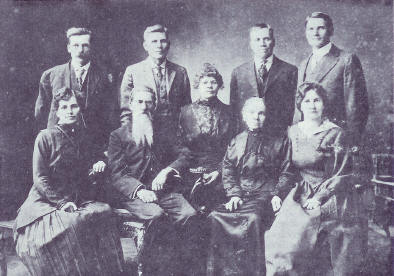
Hendrik Beernink Family. Back Row: Simon, John, Henry, Reuben.
Front Row: Hattie (Mrs. Gerrit Ellerbroek), Hendrik Willem, Ella (Mrs.
Henry De Mots), Hermina/Wilhelmina (Mrs. Hendrik Beernink),
Johanna (Mrs. George Siemen)
The Beernink's first home was a sod dugout which Hendrik built whi1e Wilhelmina and the two boys boarded at the Van Wechel home in Orange City. Hendrik crossed the prairie with a team of oxen to the Rock River, a distance of about 13 miles, to cut trees for the thatched roof of the dugout, which was then covered with sod. Fuel was also brought from the Rock River, the men starting out at midnight with a team of oxen pulling a wagon and then returning the next night with trees, some quite green so they would burn longer. Buffalo "chips" and prairie hay "twists" were also used for fuel.
One wintry day the thatched roof of the sod hut caught fire and the hut burned down, leaving the family homeless. They were offered refuge with the Johan D. Wandscheer family (their neighbor 1/2 mile away) until their home was repaired the following spring. The family was fortunate to have stored a supply of potatoes and a butchered hog in their root cellar; these were shared with the Wandscheers.
The second home was built on the line between the homestead and an 80-acre "Tree Claim" adjoining the homestead. Not having the money for the required tree plantings and other improvements, the Beerninks sold the claim to a neighbor for $1 per acre and a cow. Later a frame house was built of cottonwood, but when the wood dried, it shrank so badly that great cracks were left in the walls and ceilings. Snowdrifts would cover the floors and beds at times, causing the family to long for their warm sod hut. The two feather beds Wilhelmina had brought with her from The Netherlands ware, she said, what kept them from freezing to death!
The decade of the 1870's brought the "grasshopper plague". Swarms of
grasshoppers darkened the sky and settled to devour everything in sight.
Three years of this plague left the settlers with scant fare, but a good
crop the fourth year brought 100 bushels of wheat which was sold for $1 a
bushel. That year the Beerninks, having gone by "sun time" since their
arrival in the States, bought their first clock, a real luxury to them.
Some years later the Beerninks built a new house on the farm where they
lived until retiring to a new house in Sioux Center in 1899, at which time
their son Simon and his wife Jessie moved to the homestead. (This farm home
burned down in September of 1979, 10 months after Simon's son William and
his wife Johanna had moved out of it into an apartment at the New
Homestead).
The Beernink family were members of the First Reformed Church in Sioux Center, but before that church was organized and built, they walked to mid-week services held in a rural school house 2 miles east of Sioux Center. These services ware led by Rev. S. Bolks of Orange City. Later the family transferred their membership to Central Reformed Church in Sioux Center.
The Beerninks always had a large garden, raising almost every kind of vegetable as well as watermelon, muskmelon, end citron. They also had gooseberry and currant bushes and beautiful rose bushes. Vegetables such as sauerkraut, cut beans, and cucumbers ware all salted down and stored in 3 to 20 gallon stone crocks. Pork was also salted down or fried, covered with lard, and stored in crocks. Potatoes were stored in bins, in cellar or cave, as were cabbages, which hung from rafters, heads down. Carrots were stored in soil in crocks. No garden seeds ware available in stores, so the family selected and dried the choicest ears of corn and all kinds of vegetable seeds for the next years plantings. Eggs were often stored in oats for the winter in air tight pails which were gently turned upside down from time to time to keep the egg yolks centered. Later on when times were better, three or four barrels of apples ware bought in the fall and stored in the cellar, and every evening each one in the family enjoyed an apple.
One of the highlights of this time was the laying of the railroad track and the coming of the train, c. 1889. The working crew, who spoke a different language, lived in tents along the road, east of the Beernink home. The youngest daughter, Johanna, finally got up enough nerve to get acquainted with the workers' children and enjoyed playing with them. Sometimes they would gather milkweed pods, which their mothers would use for stuffing pillows.
Hendrik loved to travel. In 1900 he took a trip to The Netherlands and later traveled through almost every state in the Union. He attended several World Fairs and spent several winters in Mexico, Florida, and other warm climates. Denver and other large cities ware also visited by him.
Hendrik died June 8, 1925 at the age of 82 years. Wilhelmina died on September 22, 1932 at the age of 89 years. Both are buried in Memory Gardens Cemetery in Sioux Center.
Simon married Johanna Jacoba (Jessie) Van Berkum (May 15, 1879 - January 8, 1958) on June 24, 1898. They had 5 children: Mabel (Mrs. John G. Vande Berg), Grace (Mrs. Douwe Vander Berg), Esther (Mrs. G. Neal Schoep), William S., and Ella (Mrs. Gerrit J. Vande Berg). Simon died April 2, 1956. The story of this family appears separately.
John married Jennie Roos (July 2, 1877 - May 16, 1945) on June 16, 1892. They had 6 children: Helen (Mrs. Gerrit W. Hulstein), Alice, Andrew, Harold, Dorothy (Mrs. Joseph McCormick), and Gilmore. John died July 19, 1940. The story of this family appears separately. Ella married Henry De Mots (February 20, 1869 - August 1, 1911) on August 25, 1892. They had 5 children. Maude born February 25, 1893, married Eugene Edwards (December 6, 1886 - February 16, 1971) on April 20, 1923, and died December 28, 1969 in Downey, California. William E, born October 6, 1896, married Marie Mettendorf (November 5, 1896 - September 25, 1986) in May, 1921, and died November 14,1962 in Long Beach, California. Gilbert, born March 11, 1900, died in 1903. Lawrence Aaron (Bob), born February 24, 1902, married Gladys Ikhorst (August 8, 1904) in July, 1929. Bob lives in a rest home in Redding, California, and Gladys lives in Tacoma, Washington. Leona Johanna, born May 30, 1905, married Benjamin Nicholson (April 28, 1898 - March 16, 1965). Her second marriage was to Austin V. Davis (September 8, 1903 - January 30, 1975) on December 23, 1950. Leona lives in Burbank, California. Ella Beernink De Mots died May 10, 1948.
Henry remained single. As a young man he worked in the livery barn owned by his brother-in-law Henry De Mots and also lived in the home of Henry end Ella for many years. When his father died, Henry went to live with his mother, and when she became ill, Henry's sister and husband, George and Johanna Siemen, moved in with Henry end his mother. Henry remained with the Siemens until his death on July 10, 1963.
Reuben married Katherine De Gooyer (March 19, 1885 - January 4, 1944) on March 10, 1904. They had 2 children. Harold W., born April 28, 1905, married Marie Mouw (November 26, 1910), in December, 1936, and died December 6, 1978. Marie lives in Woodland, California. William R, born November 22, 1918, married Esther De Boer (February 2, 1920 - December 7, 1988) on September 18, 1944, and died on April 25, 1987. Reuben died December 19, 1951.
Hattie married Gerrit Ellerbroek (November 16, 1881 - October 18, 1950) on June 29, 1904. They had 2 children: Vernon end Willmar. Hattie died April 29, 1959. The story of this family appears separately. Johanna married George D. Siemen (November 10, 1881 - July 2, 1971) on December 31, 1907. They had 2 children. Vivian, born July 9, 1911, married Andrew George of Waterloo, Iowa on July 9, 1938 and died October 3, 1983. Myron (Mike), born September 3, 1913, married Marian Holden of White, South Dakota, on January 3, 1937, and died February 17, 1981. Marian lives in Sun City, Arizona. Johanna Beernink Siemen died November 20, 1968.
by Donna Beernink
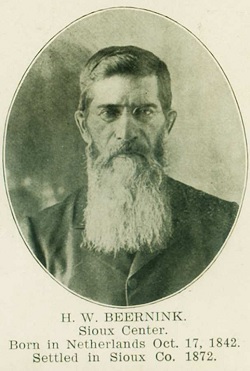
BUILT FIRST HOMESTEAD IN WEST BRANCH
Last rites for H.W. Beernink, pioneer resident of Sioux Center who died at his home June 8th after a few days illness, were held Thursday June 11th, at the Central Ref. church, where Rev. Haverkamp was in charge of the services.
Born Oct. 17th, 1842 in the Netherlands, Mr. Beernink lived in that country until a month after his marriage to Miss Wilhelmina Heideman. These days after their marriage, the couple arrived at Alto, Wisconsin where they lived almost four years. In the springs of '72 they came to Iowa and were one of the first to take a homestead on this side of the Branch river.
During their first years on these praries they experienced many hardships. They were without fuel except trees which had to be brought from the Rock river by oxen, a distance of 15 miles. They were without potatoes of coffee for two years. For several years they lived in a sod hut but in the middle of winter it was destroyed by fired and they had to move in with neighbors until they could build a little shanty. Later on an addition was build by Mr. Beernink, who had only the rudest tools for the work. The plastering was done with a butcher knife. In the little homestead their 8 children were born. One, Gerrit, died at the age of four years. The seven children are Simon, who lives on the old homestead, John, Mrs. Ella De Mots, Henry, all of Sioux Center, Reuben of Holland, Mich., Mrs. Hattie Ellerbrock of Sheldon, Mrs. Johanna Siemen, Sioux Center.
When things were beginning to look a little brighter the grasshoppers came and destroyed all living grain and vegetation. But they were persistent and and stuck by the little homestead during the dark years, which were followed by more prosperous times. They remained on the homestead until the year 1899 when they moved to the home in Sioux Center. He he continued his activities, helping in many enterprises for the betterment of the community. He was one of those who helped to organize the first creamery and one of the first banks. A year after moving to town he took a trip to the Netherlands and has since traveled through nearly every state in the Union. New countries and large cities always appealed to him. He attended several World Fairs, made a number of trips west and south to Mexico and Florida, where he spent several winters. The last few years he has gone to Denver for his vacations. He was a man of original mind and had much to tell of interest regarding his travel experiences.
Besides his aged widow and seven children, Mr. Beernink is survived by 21 grandchildren and ?? great-grandchildren. All his children were at his bedside during his last days except Reuben and family who arrived Wednesday from Holland, Mich.
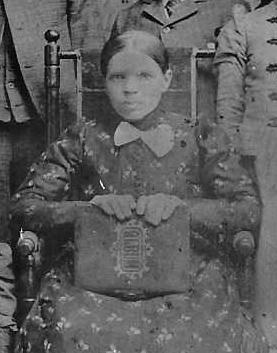
Mrs. H.W. Beernink died Thursday, September 22, at her home in Sioux Center, after a few weeks illness. She would have reached the age of 90 in December, and was one of the hardy pioneers who settled in Sioux County, stayed on through the trials and privations of those early days and lived to see marvelous changes come to the prairie country.
Wilhelmina Heidman was born in Suderwick, Germany, just across the border line from the Netherlands. In her girlhood she was employed in Holland and knew the Dutch language as well as her native tongue. In 1867, when 25 years of age, she was married to Henry W. Beernink. Three days after their marriage the couple set soil for America and after landing journeyed across the country to Alta, Wisconsin, where they lived for three years. In 1871 they joined a western bound caravan and took up a homestead one mile south and three-fourths of a mile west of what later became the town of Sioux Center. While her husband was building the usual sod hut, lumber being impossible to secure, Mrs. Beernink and two little boys stayed at Orange City with Mrs. Van Wechel.
The family lived int he sod hut for several years, until one winter day the thatched roof caught fire and the hut burned, leaving the family homeless. They were offered a refuge at a neighboring farm, that of the Wandscheer family. They were fortunate in having saved a supply of potatoes and a butchered pig which they had in their "root cellar" and these they shared with the Wandscheers, who were without food. Three years of the grasshopper plague left the early settlers with scant fare, but the fourth year they had a fine cope and sold their wheat at one dollar a bushel.
That year the Beerninks, having gone by "sun time" since their arrival in Sioux county, bought their first clock, a real luxury to them. Their 81 bushels of wheat brought the magnificent sum of $81. In the meantime they had built their second sod hut, warm and comfortable, on the line between their homestead and a 60 acre "tree" claim adjoining the homestead. A few years later they sold this claim, not having the money for the required tree plantings and other improvements, for one dollar an acre. In the "boom times" some ten years ago, this same quarter section sold for $500 an acre. Later the family had a frame house build of cottonwood, but the wood shrank so badly that great cracks were left in the walls and often when the snow sifted through the cracks covering floors and beds, they longed for their warm sod hut. Until 1899 the family lived on the farm. Then, the children having grown up and married, Mr. and Mrs. Beernink moved to Sioux Center. Mr. Beernink died 7 years ago, his passing breaking a union of 58 years. The home farm now belongs to the oldest son, Simon, who son William farms the place.
Seven children survive their mother, one son, Gerrit, having died when a small child. The surviving children are Simon, John, Mrs. Ella De Mots, Henry and Reuben, all of Sioux Center; Hattie, Mrs. Gerrit Ellerbroek, of Sheldon, and Johanna, Mrs. G.D. Siemen, of Sioux Center. There are 21 grandchildren and sixteen great grandchildren.
Funeral services were held Monday afternoon at the home and at Central Reformed Church, of which Mrs. Beernink was long a member. Rev. L. Brunsting of First Reformed Church preached in Dutch and Rev. James De Pree of LeMars, in English. Her favorite psalm, the 73rd, was sung in Dutch and a mixed quartet sang favorite hymns, "Rock of Ages" and "Asleep in Jesus." Although the weather was rainy and cold,a large number of friends gathered to honor the memory of this wonderful pioneer woman, whose devotion to family and friends and keen interest in the community continued so many years beyond the ordinary span of human life.
Alton Democrat - 23 September 1932
© Gijs van Roekel, Maarn 2006 - Ga naar begin